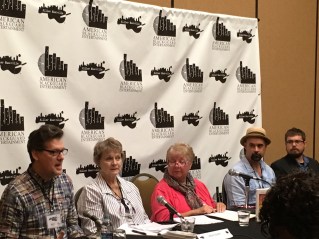
 If you thought the title was tongue in cheek you will be disappointed. I had the pleasure of hearing Ms. Evanovich speak last weekend at Killer Nashville in a variety of forums from panel to interview to presentation and in each she didn’t disappoint. (I also was able to speak briefly with her over a glass of wine at the reception afterward…. a little bonus.)
If you have passed through an airport or bookstore you likely recognize her books and you don’t have to be a fan to acknowledge that her success merits attention – 200 million books sold, I believe. In the spirit of full disclosure, I read my first Evanovich when she was on about #9 or so of the Stephanie Plum series. I was new to Kindle and wanted a book to read by the pool on an excruciatingly hot day in Phoenix. I started with number one of the series and, since I’m a quick read, needed another book later in the afternoon. To cut to the point, by the week’s end I had read all of them. The books were perfect for a great pool location – thank you Arizona Biltmore – and I downloaded seamlessly from one to the next. All the while my husband thought I was reading serious Russian literature (Evanovich, get it?).
In any business there are crossover principles to be learned (if you have major success in a hotel chain perhaps the restaurant business can pick up a pointer). This should apply to book genres as well: mysteries learn from thrillers as well as from humor or historical romance or any other success story, and of course the reverse is true. Evanovich’s principles are as universal.
Her main theme throughout the weekend was Work Hard. Seriously. In any discussion this came up. Treat writing like a job because it is a job. If you aren’t willing to do this, then you need to find a different job. Her analogy – do you drive up to 7-11 for a shift and sit in the car and decide if the muse is upon you before clocking in? Good day or bad day you go in and work. And just like a clerk or barista, as a writer you will experience the range of ‘performance’ – the day you spill the pot of coffee on a customer or consistently count out the wrong change, as well as the day when you get a huge tip. It’s a job. In the case of writing just sit down and do it.
Ms. Evanovich was asked: What does work hard mean if you have a full time job and a family and a million other obligations? Simple. It means that writing is a part time job and proceed accordingly. Do you have the ability to have a part time job one hour a day or three hours a day? Decide as if you were hiring out to work, then stick with it as a serious commitment to yourself. In the end, you will achieve your goal (a page a day and in a year you have a complete manuscript) and at the same time develop good habits that will stand you in good stead as a full time writer with a crushing publication schedule that requires sitting down at the job 8-12+ hours a day. (Here, she did a have a little be careful what you wish for moment.)
Another overarching principle Ms. Evanovich presented was be deliberate and thoughtful. In other words, plan. That encompasses myriad components of her success. What should you write? Ms. Evanovich swears she was kicked out of romance and had to decide what to do next. Why was she ‘kicked out’? Because she wanted to insert humor. When she took a break to decide what she wanted to do long term she found a genre (really invented a niche) that allowed her to do what she felt she was good at: adventure, romance and humor. This means a brutal self-evaluation – if you love reading humor but can’t write it, then stick to reading and discover your authentic voice as a writer. This is a slightly different interpretation of write what you know, write what you love, etc. Yes, you should love your genre, but you should also be able to write it. This concept worked well for Ms. Evanovich and, as I said, I won’t ever disagree with her.
There were many other topics she touched upon: the importance of the bad guy, setting, relationships within the novel or series. The list goes on and on, but in the end it is work hard, plan, work harder, keep working, and one day you will succeed. Right now I’d like to agree with that.


 If you are my agent or my editor you should stop reading. Or pour a stiff drink before continuing. Seriously.

 I need a tagline. Something appropriate for, let’s say, a bookmark. Put differently, I have to distill my entire book, the product of hours, days, months of work, into a few words. Not necessarily a sentence. A few words that suggest a sentence.
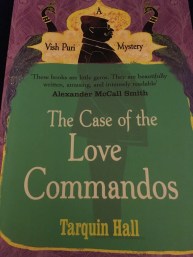 Recently I discovered the Vish Puri mysteries written by Tarquin Hall. I bought the first one at a hotel in Delhi, on the recommendation of the bookshop owner, and was immediately gratified. Hall is a Brit living in Delhi, where his hero resides, and the nuance of Indian English used by his characters is an immersion into their world. Of course, this isn’t dialect – it is the English of the country – however, it is dialogue that hints at more than the words themselves convey.
 On the other hand, there are days when you edit and see the words disappear. 32,032 is now 27,501. Yikes. I frantically do the math: How did I cut 16%? Why? A blood-letting. Now I question my judgement: maybe I didn’t need to trim that scene, cut that chapter, edit that description.
 Setting the scene… in my case Switzerland. How much is too much; how much is not enough? I have several friends who don’t ever finish their great American novel, often because they keeping digging in for more detail, more perfection, just more! (Even more editing, which often means ‘less,’ then they need ‘more’ again. Argh!)
 Tracee de Hahn