 I recently spoke to a middle school class in Athens, Tennessee and was impressed by their thoughts on writing, what they were writing and how excited they were about the entire process from inspiration to words on paper to editing (which they informed me was the hardest and most important part!).
In this class, and when I meet children or young adults with their parents, one of the inevitable questions is what should I do if I want to be a writer? That’s a loaded question but one of the things I usually mention is name recognition through competitions. (After all, practice and potential resume building aren’t bad for anyone.) Inevitable we talk about short story competitions. Why? There are quite a few of them. And while writing a short story isn’t easier than writing a full length novel it is ‘shorter,’ which hopefully translates into a shorter timeline for completion.
While name recognition for a contest winner or short story publication is a great thing, there are other wonderful reasons to tackle the short story.
Perhaps most importantly, it is a tool in development of writing craft. Short stories may be short but they have a beginning, middle and end. Their length makes it all the more critical to distill all knowledge into an abbreviated word count. A good short story will always be tight and succinct (whereas a novel can legitimately be lengthy). That leads to the part that the middle schoolers felt was the hardest and most important – editing. A masterful short story is a well edited story.
This doesn’t mean that a short story edits out theme or twists or experimentation with POV or any other of the other things that writers use in full length novels. The short story provides space for everything, just judiciously. A theme is the heart of any story!
Recently I asked a short story writer what was their biggest piece of advice. The answer: start the story very near the end.
Are you a short story writer? Any advice? Any favorites?


 This post appeared concurrently on MissDemeanors.com, which was recently spotlighted in Writer’s Digest as one of the 101 best blogs for writers. (And it was one of only three named specifically for the mystery genre.) It was a thrill for our group – our Andy Warholian fifteen minutes of fame!
 I believe that there should be enough detail to get close to what the author imagines, but I can sympathize with the notion that too many details are information overload for a reader. This came up in my conversation with my neighbor. Afterwards it struck me that the average reader’s access to information has altered what we want. Think of Charles Dickens or Leo Tolstoy or Victor Hugo. These men were literary giants in their day, hugely popular in every sense of the word. They set a scene that was possibly unimaginable to their readers – a glimpse of the darkest side of industrial England’s workhouses and slums and law courts. The vast battle fields of Russia and the gaiety of aristocratic balls. The dark currents of Paris, including those running under the streets. These scenes were so finely wrought that they are useful to historians today.


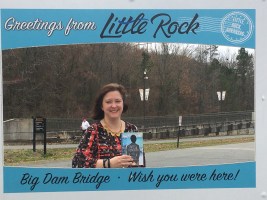

 Amazing dinner with friends in Lexington, Kentucky last night to celebrate the launch of Swiss Vendetta! What a pleasure to see old friends and to share such meal.
 Every writer is on their own schedule. For me, it’s that time of year. The heaping stack of printed paper that is my manuscript will make its way to a box and then to the attic.
 Tracee de Hahn